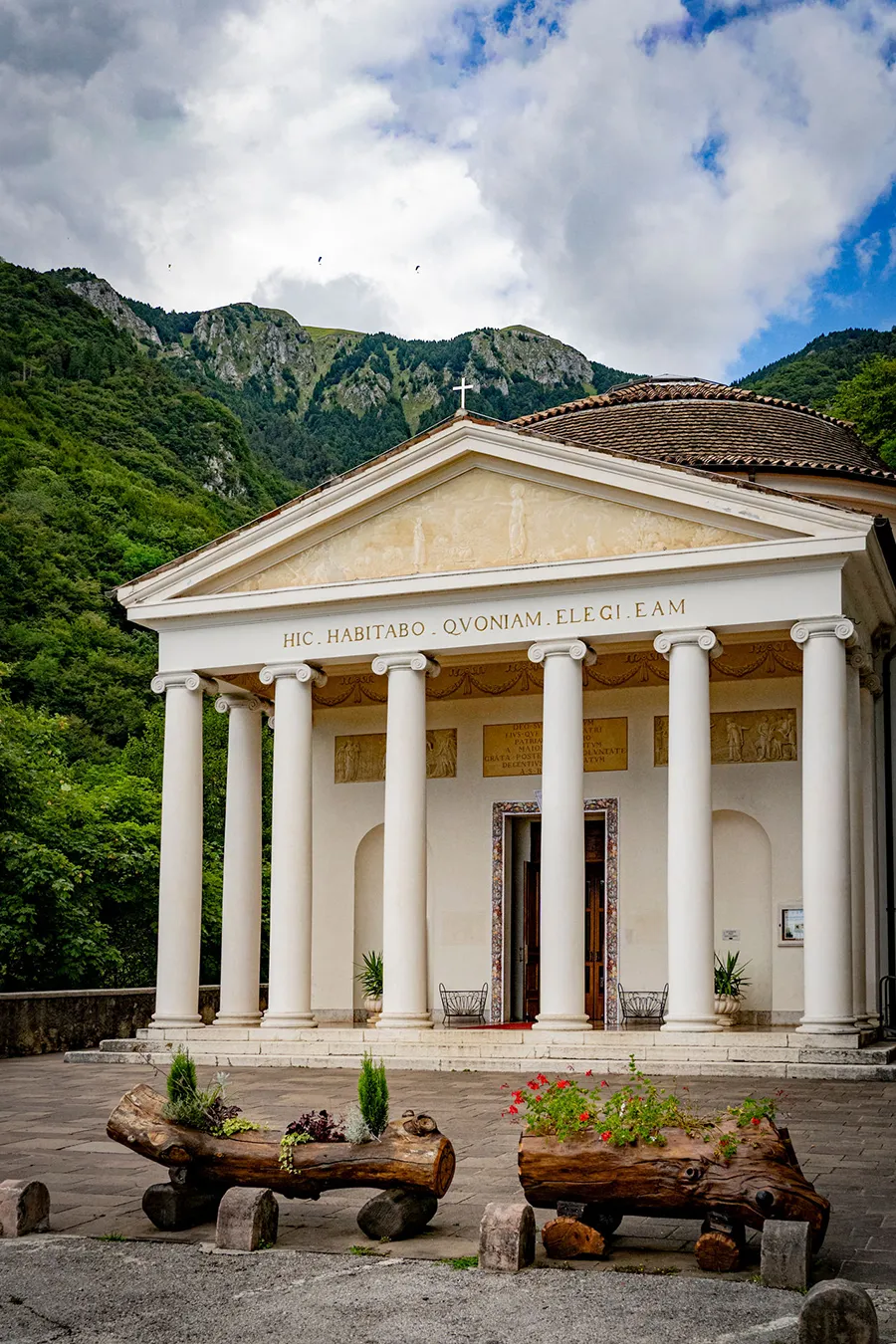
Located at the foot of the Frontal, at an altitude of just under 600 meters, the Sanctuary of the Madonna del Covolo has always been the Christian place of worship most dear to the people of the Pedemontana del Grappa, as also attested by the suggestive locality of Tre Busi, reachable through a pleasant walk of a few minutes to the bottom of a narrow valley. The first foundation of the oratory, oriented from north to south, with its side leaning against a wide and once more prominent rocky wall, probably dates back to the second half of the 12th century, to commemorate the apparition of the Virgin to a deaf-mute shepherdess of the Vaccaro family, who even today is said to preserve a wooden statue called the Madonna dei Vaccari, according to tradition, sculpted not long after the apparition. Perhaps a 1750 wooden ex-voto reproduces the original silhouette of the sanctuary: a rather small church, simple in design, harmonized with the surrounding unspoiled environment. Tradition holds that, “since it was impossible to build under that rock [rocky spur], the foundations were traced on a gentle slope and soon the first stone was laid” : this would be the present Capitelo su in Nogarè, dating back to the 12th century with significant 17th-century transformations, which, before its partial collapse in recent years, featured a stone architectural composition, with a raised arch with a keystone supported by two stone pilasters, housing a Marian fresco covering all three internal walls. Intensely linked to the religious life of the town, the church of Covolo is governed by an ancient and influential Confraternity or School of the Blessed Virgin of Covolo, already active in the 15th century and of ancient origins. The sanctuary in its current form is due to the design of Antonio Canova, who joined the Confraternity in 1799, and was erected over five years, from 1804 (with the drafting of the project) to 1809. The executor, under the direction of the exceptional designer, was Gio:Batta Zardo detto Fantolin from Crespano, a cousin and intimate of the sculptor. Zardo personally worked on the project in Canova‘s Roman studio and was therefore able to interpret the master’s desires and tastes. Canova‘s inspiration came from the Pantheon in Rome, and not by chance: in the designer’s mind, the imitation of the classical model aimed to respect the primitive shape of the oldest oratory of Covolo, which seems to have been round or, more precisely, octagonal. The Canova project maintained the original structure of the ancient small church, developed it to the south with a noble and elegant rotunda (13 meters in diameter) and completed it with a facade embellished by a simply designed atrium, externally closed by a peristyle of eight Ionic columns supporting the triangular pediment, within which is a harmonious chiaroscuro with the subject of the Apparition. At the base of the pediment, above the entrance door, the dedication “Hic habitabo, quoniam elegi eam” is inscribed: “Here I will dwell, for I have chosen it”. Beneath the attic, at the sides of the dedicatory epigraph, are two other chiaroscuro paintings: Ahasuerus with Esther at his feet and Abigail presenting food to David, which, together with the Apparition, were designed by Canova and executed after the inauguration in 1809. This is read in Canova‘s correspondence to Fantolin, when the sculptor showed himself so satisfied with his design that he soon undertook to build the Temple in Possagno following the same model as Covolo: “You have with you the model of that round Church made while you were here. Now you must make an exact survey of it, and determine the necessary expense for its execution… I would then like this rotunda to be reduced to its greatest simplicity, and by this I would mean suppressing in that factory the rooms that surround it [sacristy and adjacent parts of Covolo, which break the harmony of the design] and all parts that can be left out without disturbing or destroying its elegant and noble character… The experience you gained in the construction of the rotunda of the Madonna del Covolo can be very useful for the way to execute this other one with the greatest simplicity”.
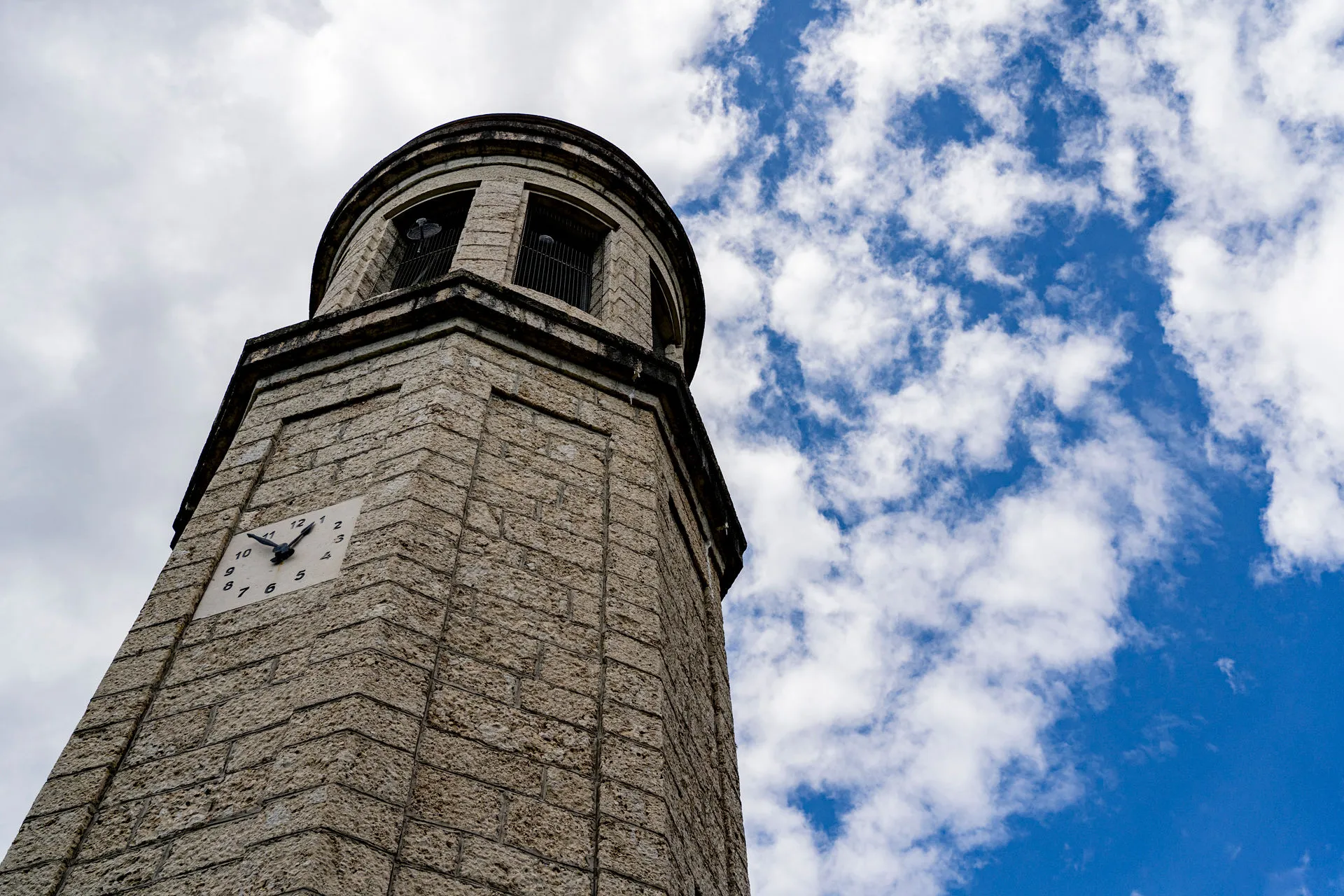
Thus, the compositional and artistic experience of Covolo seemed so positive that it had to be imitated without a doubt in the construction of the larger building, which was about to be erected in Possagno. In 1844, the current two-kilometer carriage road was opened in just forty days of work, thanks to the free labor of thirty-four neighboring villages. Before the Great War, solemn and centuries-old chestnut trees still stood and enveloped the road, intertwining to form a very long and picturesque gallery. In 1845, faced with yet another landslide from the upper side of the mountain that overwhelmed the small choir and sacristy, the first interventions were subsidized mainly by Bishop Sartori Canova, the sculptor’s half-brother, who had also just contributed to the road’s expenses. The choir, altar, and sacristy were greatly improved and, above all, enriched with marbles: the four original statues by Bernardi Torretto from Pagnano, overwhelmed by the collapse, were replaced by those of Saint Anne and Saint Elizabeth, by an unknown author. Between 1902 and 1905, a fundamental renovation of the entire building was undertaken on the initiative of Rector Pietro Prevedello and the Crespano parish priest Don Natale Vareton, based on designs by engineers Zardo and Favero, with substantial contributions from the Canova Legacy, disbursed by the executor Filippo Canal: reinforced foundations, restored dome, enlarged choir to add further capacity to the church. The interior is decorated not only by the Joyful, Sorrowful, and Glorious Mysteries painted by Carlo Vendramin, but also by numerous frescoes by the priest Demetrio Alpago, with images of evident catechetical function: on the dome of the rotunda, the Glory of Angels (and the coffered decoration) ; in the choir, after the four Ionic columns that separate it from the rotunda, the Blessed Virgin blesses Crespano, the Nativity of the Virgin – perhaps his most significant work – the symbols of the Marian religious orders, the ceiling decorations, the corner coats of arms (of Pope Pius X, the Canal family, Bishop Sartori Canova, Cardinal Callegari) and, finally, the statues of Saint Joseph, Saint Joachim, Saint Zechariah, Saint John the Baptist. Of the high altar, original to the old small church, only the statue of the Virgin remained miraculously intact after the collapse of 1845, as old records relate. The choir confessionals are by Zardo Fantolin. Between 1910 and 1912, the last contributions gave the interior its current appearance: the four altars of the rotunda were erected ; of their four altarpieces, the only one surviving the 1976 theft is the Transit of Saint Joseph, a work by Stefano Serafin, the devoted restorer of Canova’s plaster casts in the Possagno Gypsotheca. During the First World War, while the town was targeted by enemy cannons and airplanes, the Sanctuary, involved in military operations, was used as an ammunition depot, surrounded by other depots and cableways and the incessant passage of troops ; subsequently, cleared out, from January 1918 it served as an infirmary for the wounded descending from Grappa. The construction of the bell tower, designed by architect Fausto Scudo in 1937, was aided by a flood of men and women from the town, who hand-carried bricks to the Sanctuary. The Sanctuary of the Blessed Virgin of Covolo, perched on the slopes of Monte Grappa in Crespano del Grappa, is a place where spirituality, history, and architectural beauty come together.
According to local tradition, a legend tells that in the 12th century, the Virgin Mary appeared to a shepherd girl who had taken refuge in a cave (Covolo in the local dialect) during a storm, curing her of deafness and muteness. In honor of this miraculous event, a chapel was built, later expanded into the current Neoclassical structure, designed between 1804 and 1809 by Antonio Canova as a preliminary exercise for his later masterpiece, the Temple of Possagno.
The building has a circular plan with an Ionic portico, columns, and a triangular pediment. Next to the rotunda, the original ancient chapel can still be seen, carved into the rock behind the apse. The interiors feature 20th-century frescoes by Don Delmetrio Alpago.
The path leading to the sanctuary is an experience in itself: built in 1844, it is lined with fifteen small shrines depicting the Stations of the Cross and the Mysteries of the Rosary, offering a meditative journey along the ascent.
From a tourist perspective, the Sanctuary is an ideal destination for those who love scenic landscapes, spiritual reflection, and peaceful surroundings. From above, visitors can enjoy a panoramic view of Crespano, the surrounding hills, and the Prealps.
It is also a starting point for hikes and pilgrimages toward the summit of Monte Grappa.
From the Sanctuary, you can reach the Tre Busi spring, where the Madonna appeared and caused water to flow from the rock.
The site is easily accessible on foot, but comfortable shoes are recommended.
Address
Via Madonna Del Covolo, 148, 31017 Crespano di Pieve del Grappa (TV)
Opening Hours:
Monday to Saturday 4:00 p.m. – 5:30 p.m.
Sunday: 10:30 a.m. – 11:30 a.m. | 4:30 p.m. – 5:30 p.m.
Phone number:
0423 53206
E-mail:
crespano@diocesipadova.it
santuariomadonnadelcovolo@gmail.com