CRESPANO CATHEDRAL
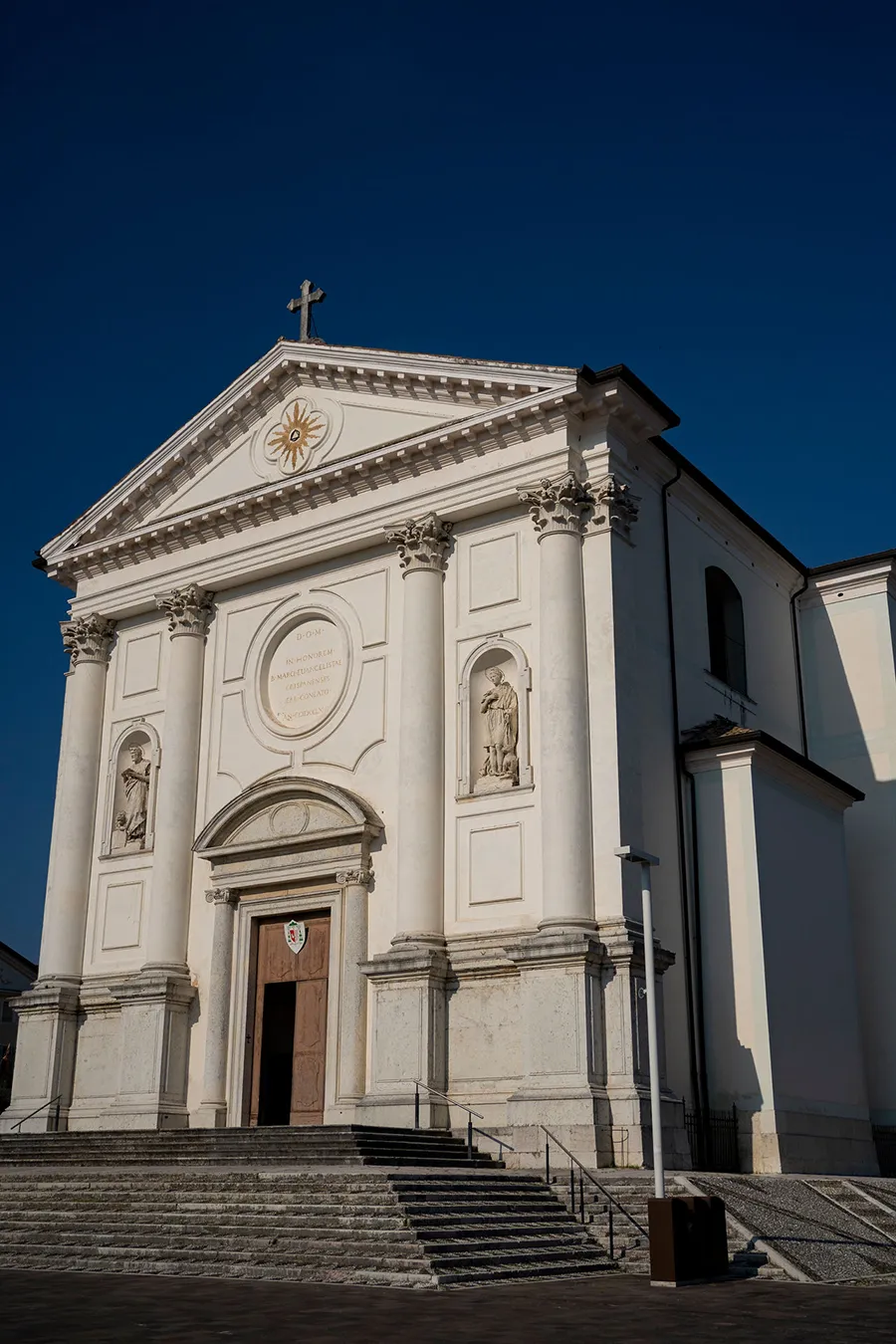
The Duomo is Crespano’s identifying landmark, as well as an artistic, architectural, and artisanal treasure that certainly deserves a careful visit to discover its details. The old parish church of San Marco (10th – 12th century) was neither large enough for the increased population nor dignified and ornate enough for the wealth the town had acquired. The community therefore contacted the Venetian architect Giorgio Massari (1687-1766) to design what is now known as the Duomo, dedicated to Saints Mark, Pancrazio, and Paul, although the official formula omits the second co-patron, assumed in 1488 upon the incorporation of the parish of San Paolo. The context should be briefly illustrated: from 1600, Crespano had assumed a role of great importance in wool production: water-powered mills fueled the spinning mills of entrepreneurial families ; in each small workshop, in each home-business, hundreds of Crespano residents and others found work ; wool cloths were often shipped to Venice and sold in Eastern markets. Against the backdrop of this productive activity, the memory of the dispute between the two most important wool families – the Manfrotto and the Melchiori – regarding the choice of the site for the new parish church survives in Crespano’s historical tradition. The proposal of the entrepreneur Francesco Melchiori prevailed, as he committed to purchasing the land and providing the initial funding. The designated location, adjacent to Ca’ Melchiori, is a short walk from the old San Marco parish church and, in a way, ensures the ideal continuity between past and future. The Manfrotto family, who wanted the church in a more central position and closer to their district, Gherla, retreated into cold isolation and did not participate in any way in the expenses of the new construction.
Giorgio Massari is one of the most prestigious names of the period, author of Palazzo Grassi and the Gesuati church in Venice, and villas in the Venetian hinterland such as Villa Tamagnino in Istrana and Villa Cordellina in Montecchio Maggiore. In the Pedemontana del Grappa, he had already worked on Villa Fietta in Paderno and the oratory of Villa Perusini in Castelcucco. Giorgio Massari’s works show influences from Palladio‘s 16th-century dictates and the presence of Longhena‘s 17th-century Venetian Baroque architecture ; nevertheless, the author filters tradition through strong personal creative talents that often set him against the current. When designing the new Crespano parish church, Massari architecturally referenced himself: he drew inspiration from the Gesuati church on the Giudecca canal, simplifying its decorative elements, adapting the typology to a rural environment, and giving it characteristics that made it, among the 18th-century churches in the Pedemonte, the most representative in terms of size and artistic value, and decidedly unique in its location in the center of a square.
This prestigious undertaking began and was realized through the commitment and work of the entire community: from the activity of the parish priest Don Felice Ziliotto and the churchwardens to the financing from merchant entrepreneurs, the offerings from confraternities and those collected house by house, and the labor of masons, stonecutters, farmers, and sometimes even women themselves. Construction, begun on October 3, 1735, lasted 27 years until 1762, with consecration in 1766 by Mons. Razzolini, Bishop of Santorini, with the authorization of the Bishop of Padua. In 1975, by decree of the Bishop of Padua, the church was elevated to the dignity of a Duomo. The architectural layout of the Duomo falls within Massari’s typical construction and aesthetic methods ; what differentiates it, however, from 18th-century churches in the rural area of Veneto is its remarkable size, made even grander by the wide front and side staircases.
The church’s dimensions, with a single nave, are 34.50 x 16.20 meters and can give an idea of the many and varied technical and constructive difficulties involved in the completion of the work. The building materials – bricks, lime, stone, and wood – are elements of the simple but ancient building tradition of the Pedemonte del Grappa. The long duration of the church’s construction was ultimately due to the difficulties linked to the economic and commercial decline that began to manifest itself as early as 1740 with the opening of Eastern markets to more competitive European nations. The architecture of the Crespano cathedral, in its balance, is a typical composition by Massari when he engaged in building country churches. With a single nave and rectangular plan, the large volume is even more imposing because it is enhanced by its elevation above the surrounding square area. The facade, facing west, sober and devoid of too many decorative elements, is divided into three vertical sections, separated by four large semicolumns resting on squat stone bases. The central portion, the largest and most important, rises from the floor to the architrave of the pediment: it contains the entrance portal, with its two side pilasters and a lunette pediment ; above it, a large oval houses the dedicatory inscription to Saint Mark the Evangelist. The two narrower side sections contain, at half height, large niches in which the parish’s patron saints are placed: Saint Mark, a work by Stefano Serafin, and Saint Pancrazio, a work by Francesco Sartor. The large triangular, classical pediment, resting on the Corinthian capitals of the four semicolumns, completes the facade with a sacred emblem. Above, a solitary marble Latin cross.
The external elements of Massari’s churches usually also hint at the internal arrangement ; on the long sides, the side chapels protrude from the main volume: the two central chapels are larger, while those at the ends of the sides are smaller. Above them, large thermal windows illuminate the vast nave. With an intervention in 1929, the original east apse was lost, now lengthened and semicircular to house a large choir loft behind the high altar, where the new organ is located. Internally, the building reproduces the elements and movement of the external facades. Along the entire perimeter of the nave, the semi-pilasters, starting from the mighty bases, follow each other at regular and symmetrical intervals, leaving space for the side chapels: the central ones are larger and brighter, the side ones discreet and contained, then rising to the Corinthian style capitals, a work by Vincenzo Merlo from Vicenza.
The ceiling decoration was entrusted to Jacopo Guarana (1720-1808), an artist of the Tiepolesque school, highly esteemed and very active in the Venetian hinterland. On the vaulted ceiling of the nave are frescoes of the Ascension with the Cardinal Virtues and the Theological Virtues ; above the choir, the ethereal Triumph of the Cross. In the Tiepolesque school frescoes, skies, clouds, and angels appear in swirling upward movements, in a combination of diaphanous and light colors. Also by Guarana are the chiaroscuro paintings on the back walls of the Duomo, the oil on canvas depicting Saints Mark and Pancrazio, patrons of the parish, with Saints Peter and Paul, and the canvases depicting the Deposition from the Cross and Saint Aloysius Gonzaga. On the altars near the choir are canvases painted by Gerolamo Dal Ponte (1566-1621), Jacopo’s son, depicting Saint Francis on Mount La Verna, receiving the stigmata ; opposite, the Virgin with Saint Sebastian and Saint Roch, attributed to Paolo Veronese (1528-1588), these works coming from the previous parish church of San Marco. The large canvas above the entrance portal is The Translation of the Body of Saint Mark by Antonio Molinari (1655-1728). In the sacristy are preserved the Supper at Emmaus by Alessandro Maganza (1566-1630) and the old 15th-century fresco depicting San Prosdocimo from old San Marco. In 1852, the Belluno painter Giovanni De Min (1786-1859) was commissioned to fresco the side walls of the church with a saintly cycle. In addition to the images of the twelve apostles, he also added ten other saints and the two large representations of the presbytery. Near the church entrance is the Deposition from the Cross, a plaster cast by Antonio Canova (1757-1822), donated to the Crespano community by his brother, Bishop Giovan Battista Sartori.
Massari, in all the constructions he designed, typically meticulously planned the furnishings and all decorative and complementary parts, then entrusting their execution to skilled craftsmen and artists he trusted. The high altar, reminiscent of the Santissimo altar in Padua Cathedral, also designed by Massari, was crafted by Ludovico Torresini, and was the first to be placed in the church at the time of its consecration in 1762. In the center, the tabernacle, crafted in green and red polychrome marble, appears as a miniature temple surmounted by a Baroque-style bulbous dome. On either side are two marble angels by Bernardi Torretto of Pagnano (1694-1774). The same Baroque influence is noticeable in the design of the side altars, articulated on two levels, seeking a greater effect of depth, achieved in the two pairs of columns and the two differently shaped and offset pediments ; the upper one with a lowered arch and the lower triangular one. An angel’s head acts as the keystone to the arch enclosing the altarpiece of each altar. The marble colors of the altars are delicate: white and blue in the two central ones, red in the four smaller ones.
All the wooden furnishings of the cathedral, although realized after the consecration, were conceived and designed by Massari, who also studied their placement, arranging numerous free wall sections along the walls to which the furnishings could be attached. The dark wood confessionals with uniform color have a classical structure that is enlivened by the Baroque shape of the front facade and the curvilinear solution of the roof. Particularly important is the baptistery, which, in its undulating lines, echoes the tabernacle of the high altar and reproduces the varying light of the marbles in the skillful play of the briarwood. The same play of veins is found in the choir stalls that align along the sides of the presbytery, reproducing the classical structure of the confessionals. The realization of the wooden furnishings is the work of the brothers Domenico and Zuane Zardo Fantolin, capable exponents of a high-quality cabinet-making workshop active in Crespano until the end of the 19th century.
There have been two significant variations from Massari‘s original idea. The first intervention in the mid-19th century was by De Min, with the creation of frescoes that profoundly changed the lighting effect inside ; the other major modification occurred in 1929, when, based on a project by architect Scudo, a serliana was created behind the high altar, formed by a central arched opening and two smaller lateral ones, to accommodate the choir loft and the removal of the primitive wooden pulpit that contained Nacchini‘s organ.
CRESPANO SQUARE
The construction of the magnificent Parish Church, the future Duomo of Crespano, in the second half of the 18th century, marked the beginning of a radical urban transformation of Crespano’s center, completed at the beginning of the 20th century with the construction of the Bell Tower. A church of such value and dimensions consequently required the design of a surrounding space that could serve not only as a suggestive architectural setting but also as a concrete and convenient place for public gatherings, collective ceremonies, and all mercantile and commercial activities, in the face of a growing demographic impulse that the town experienced between the 17th and 18th centuries. As early as 1795, Crespano obtained the institution of a free fair to be held “in the square and annexed places or the rural area of Crespano, on every second Monday of each month”. For this reason, between 1849 and 1860, based on a project by the Feltre architect Giuseppe Segusini (1801-1876), the low, elongated building was constructed to the south, defining the square’s boundary, housing shops and stalls for haberdashery, fabrics, and various artisanal products. In the center, the row of shops is interrupted by a neoclassical portico with four columns, decorated with a fresco by De Min, which was intended to serve as an external atrium of a theater. Of the original project, never completed, in addition to the atrium, the large entrance hall with two side doors remains inside, which housed the historic Caffè Canova, once a meeting place and leisure spot for the people of Crespano and the Pedemontana region. Facing the church’s facade stands the octagonal fountain donated by Sartori Canova in 1834. To the west is the stone entrance arch to Ca’ Melchiori, later “Francesco Aita” Civil Hospital, now a Retirement Home. To the north of the Duomo is the Free Fair Column (1795), which supports the lion of St. Mark and commemorates that the Republic of Venice granted Crespano the right to host a monthly fair, an event that eventually transformed into a Sunday market.
CRESPANO BELL TOWER
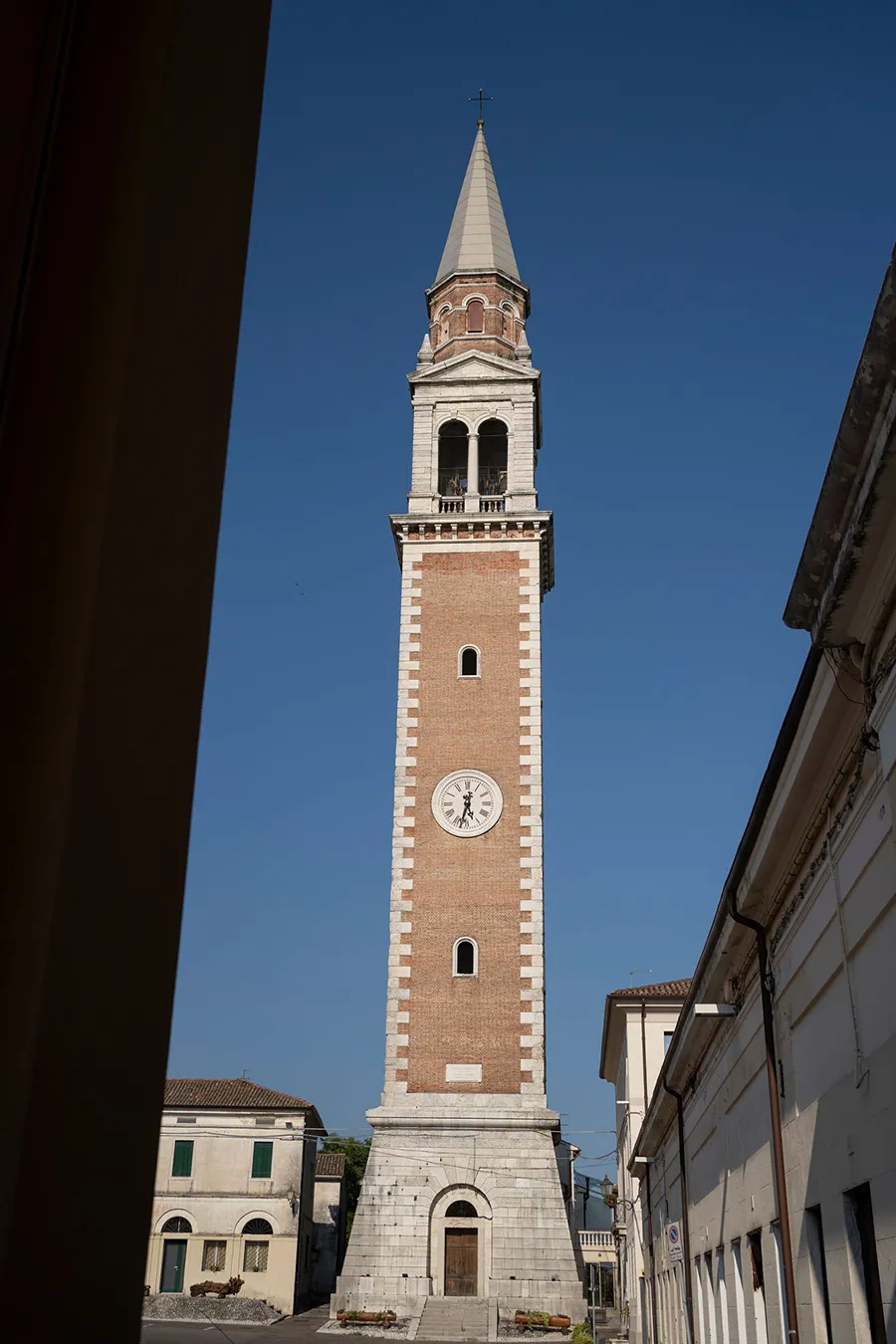
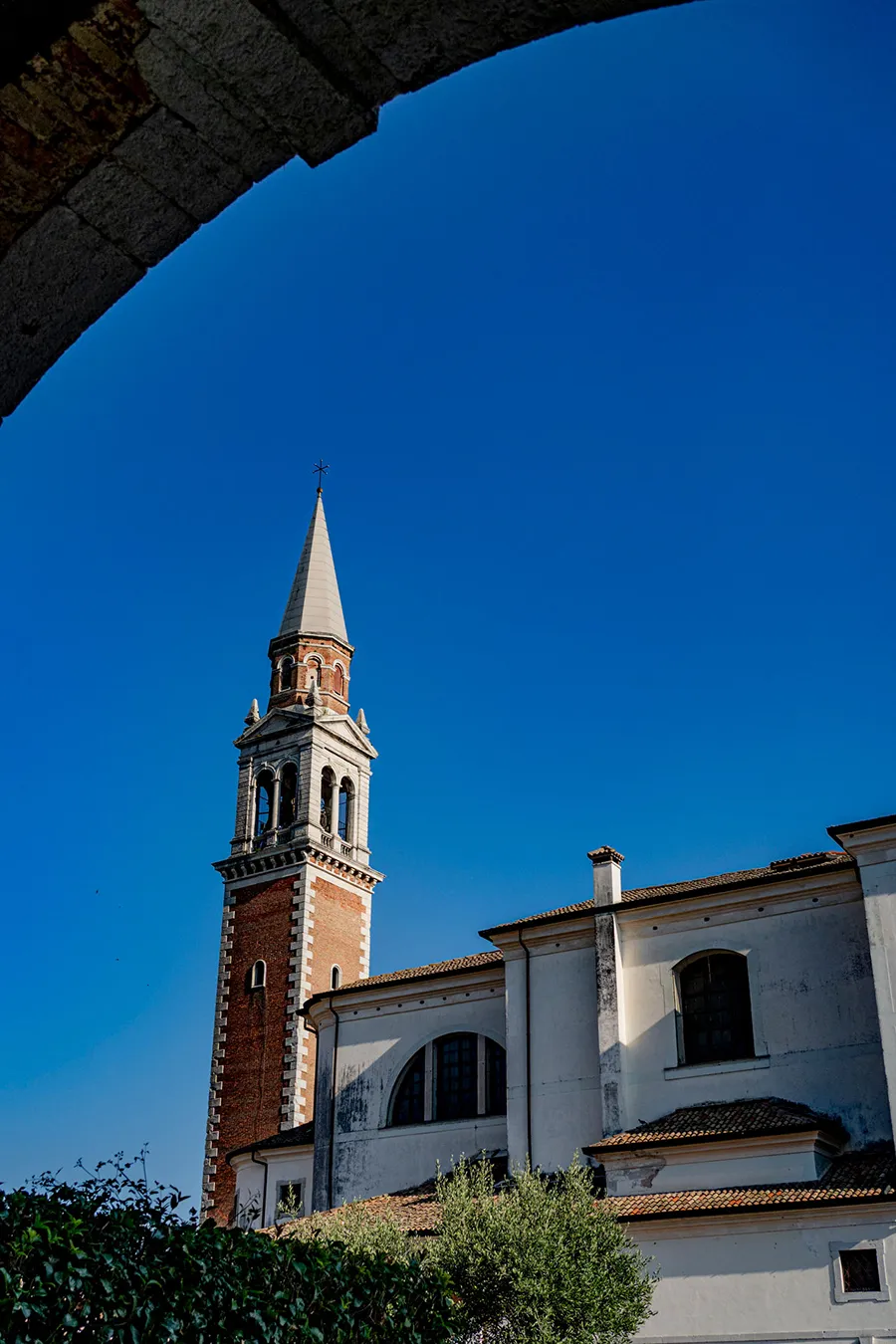
In the second half of the 19th century, with the reconstruction of the new rectory, space was created for the construction of a majestic bell tower. A “commission for the construction of the new bell tower,” chaired by parish priest Don Natale Vareton, in July 1869, having raised all possible funds, proceeded with the start of works based on a design by engineer Antonio Zardo. Once the base was completed, in a few years, the construction site stopped due to the poor economic conditions of the community and political conflicts within the ruling class. Towards the end of the century, after a long period of stagnation, thanks also to funding from the mayor and count Filippo Canal (1811-1904), the work could be completed. The initial project for a stone tower was abandoned to make way for an imposing and modern bell tower, inspired by St. Mark’s of Venice, which was inaugurated in September 1900.
Address
P.za S. Marco, 46, 31017 Crespano di Pieve del Grappa (TV)
Phone number
0423 53065
E-mail:
crespano@diocesipadova.it