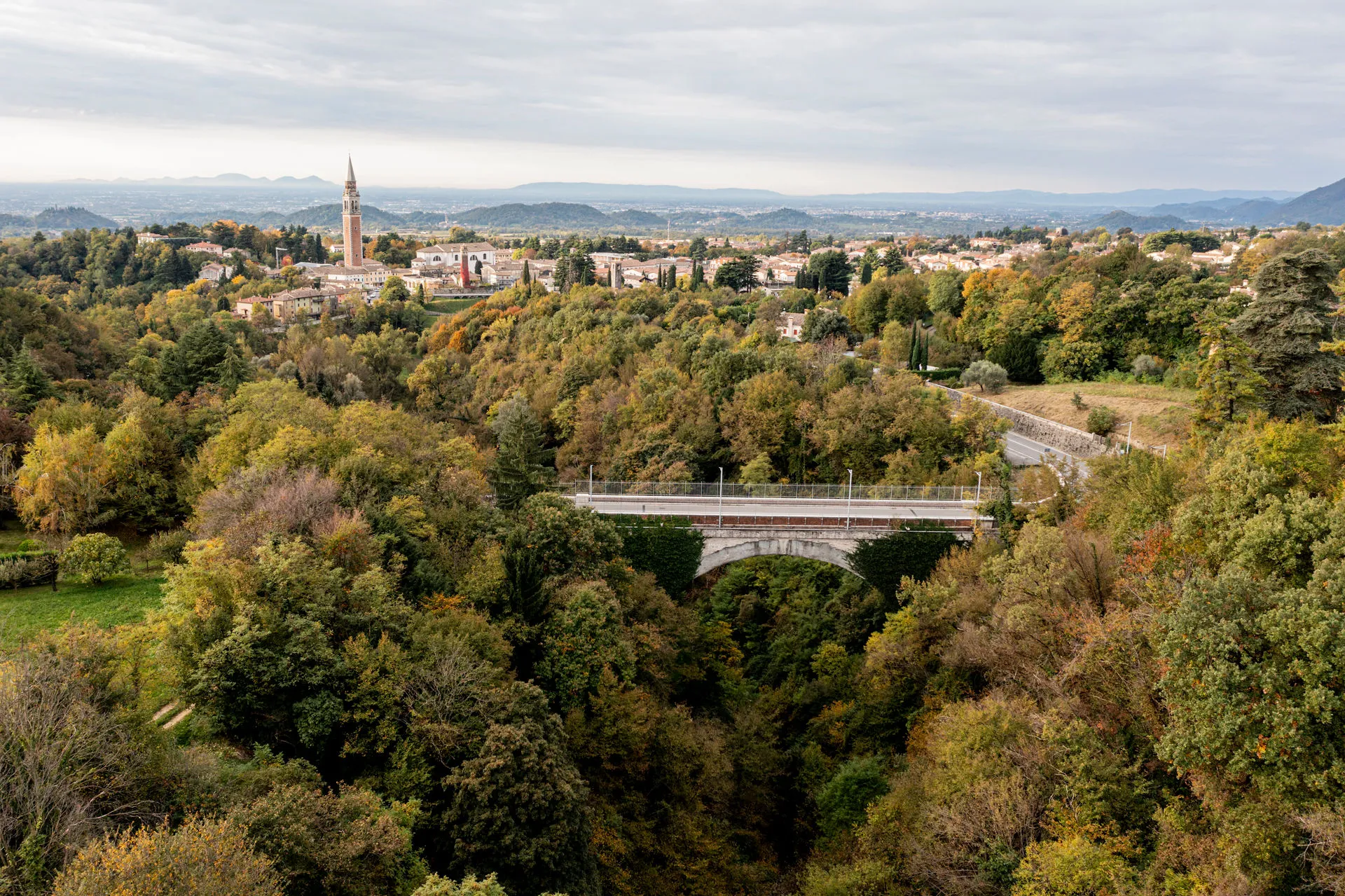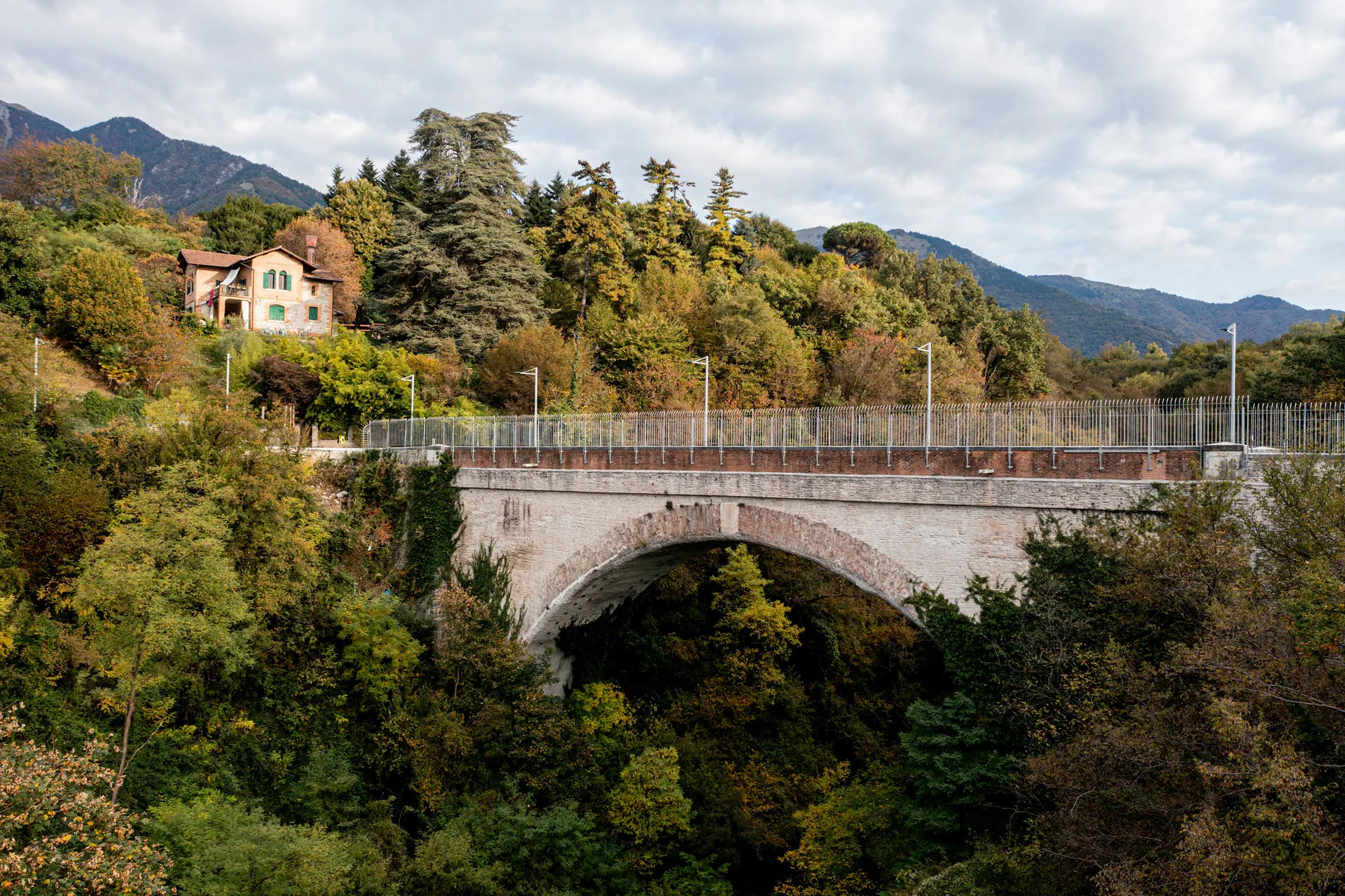
During the period of Austrian domination, it was decided to build the new Molinetto road to connect the Via Regia Cornuda – Feltre to Bassano through Pederobba, Possagno, and Crespano. To cross the Lastego torrent, the project included the construction of a single-arch bridge at a site north of the previous crossing (the Salto), where the valley narrows before entering the pre-mountain morphological uplift. The project, financed by Mons. Sartori Canova, was entrusted to engineer Casarotti and completed in 1829 with the inauguration by Viceroy Ranieri d’Asburgo in 1830.
However, it is appropriate to contextualize the construction of this artifact. Until the end of the 18th century, the communication routes connecting the towns of the Pedemonte had a rugged environmental morphology and a difficult obstacle to overcome. The Lastego torrent, in fact, lacerating the sub-mountain belt with its deep bed, was crossed at different points and in different ways: with a wooden walkway in the Salto locality, corresponding to the current embankment that now connects the center of Crespano and the S. Michele locality in Paderno ; with an old stone bridge (the original has disappeared) in the current Andreatta locality, in San Paolo; with the carriage ford of the ancient Via Piovega, on the southern border with Fonte, once also equipped with a pedestrian walkway. Furthermore, there were frequent passages on foot or with animals to reach the woods, pastures, and milling plants or to pilgrimage to places of devotion such as the Sanctuary of the Madonna del Covolo: there are at least three fords north of the Salto, and there is above all the old route of the Via Feltrina, rather linear in the stretch that goes from the Ciope Vecie, between Possagno and Fietta, to the Lastego. Moreover, the great development of the wool art and market, between the 17th and 18th centuries, seemed to privilege the main trade and exchange routes in the north-south direction towards the plain markets and maritime ports in the lagoon, leaving mobility along the pedemontana belt in the background. Only in 1819 did the cloth manufacturers feel “the need to open a new road connecting with Cavaso, to facilitate the journey of workers arriving in Crespano” and to provide better communications between Bassano and the towns, particularly Possagno, to admire the Canovian temple, which had just begun in 1819.
The project, financed by Mons. Sartori Canova, was therefore written about, as was the entrustment of its realization to engineer Casarotti. A few days later, after the inauguration by Viceroy Ranieri d’Asburgo, on May 2, 1830, a devastating crash announced to the incredulous population the collapse of the structure. Regarding the reasons for the collapse, chronicles report that, compared to the original project where the use of terracotta bricks for the entire arch was foreseen, for economy, local Mavier stone elements were used, so irregular as not to guarantee the perfection of the arch’s geometry: “The irregularity of the pressures, consequent to that of the material used, as soon as it was dismantled, the arch caused a lateral displacement which was the cause of the immediate ruin of the bridge on May 2, 1830”. Having raised funds, the reconstruction was entrusted to engineer Coronini, who, still convinced of the goodness of the original project, had it rebuilt with the planned materials. Having survived the Austrian grenades of the Great War, after almost two centuries and a reinforcement intervention, the majestic bridge continues to showcase itself, vigorously extending between the two steep banks of the Lastego.