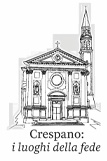
San Pancrazio in Crespano, due to its location and orientation, shares similarities with other churches in the Pedemonte area: its rugged position, on cliffs or hills accessible only from one side and well-protected , and its apse facing east, according to the module of the primitive Christian churches of the Pedemonte del Grappa. The facade, facing the cypress-lined avenue leading to the center of Crespano, has a typically rural essentiality: the entrance door is flanked by two rectangular windows and a small oculus in the center of the pediment, which is completed by a light cross on the ridge. The nave, topped by a regular succession of mighty wooden trusses covered by joists and triangular-patterned tiles, features tombstones on the floor of some families who contributed to the construction of the present parish church and leads up one step to the altar. On the south side, a stone holy water font with an angel’s head is next to a small door leading to the sacristy.
Its ancient origin is understood from its dedication: between the 12th and 14th centuries, the church was dedicated to San Pancrazio and San Marco, to emphasize the primacy of the patron saint of the diocese of Padua. When Venice became interested in the hinterland at the beginning of the 15th century, the names of the patron saints were inverted, becoming San Marco and San Pancrazio. Founded probably in the 11th century, it was the first parish church of Crespano. It is mentioned for the first time along with other Crespano churches in the pontifical tithes of 1297. However, assuming that the saintly cycles effectively testify to a specific historical era, the title of San Pancrazio (an adolescent victim of Diocletian’s persecution) would suggest its origin in the Byzantine-Ravenna period (6th century AD). From the acts of the pastoral visit of September 1488, we learn that the church had three altars, one of which was unconsecrated and one to be demolished. In the subsequent 16th century, the church of San Marco was restored and enlarged, overshadowing San Pancrazio, which nevertheless stood out for its rectory and cemetery. In the pastoral visit of 1633, the old wooden high altar is recalled. The altarpiece depicted the Virgin with Saints Mark and Pancrazio on either side. Giambattista Verci (1775) instead recalled an altarpiece by Jacopo da Ponte depicting the Virgin, Infant Jesus, Saint Roch, and Saint Sebastian. Similarly, Monsignor Federici (1803) noted: “In Crespano, in the ancient Parish Church of S. Pancrazio, the altarpiece to the right of the main one with the Blessed Virgin holding the Child with cherubs, S. Rocco and S. Sebastiano is also by Giacomo.” The earthquake of Santa Costanza (February 25, 1695) did not cause serious damage in Crespano but highlighted the need to restore all the sacred buildings in the town. The parish priest at the time, Don Valeriano Manfrotto from Crespano, dedicated himself to restoring the churches affected by the calamity and consolidating the cultivation of vines and fruit trees.

Its ancient origin is understood from its dedication: between the 12th and 14th centuries, the church was dedicated to San Pancrazio and San Marco, to emphasize the primacy of the patron saint of the diocese of Padua. When Venice became interested in the hinterland at the beginning of the 15th century, the names of the patron saints were inverted, becoming San Marco and San Pancrazio. Founded probably in the 11th century, it was the first parish church of Crespano. It is mentioned for the first time along with other Crespano churches in the pontifical tithes of 1297. However, assuming that the saintly cycles effectively testify to a specific historical era, the title of San Pancrazio (an adolescent victim of Diocletian’s persecution) would suggest its origin in the Byzantine-Ravenna period (6th century AD). From the acts of the pastoral visit of September 1488, we learn that the church had three altars, one of which was unconsecrated and one to be demolished. In the subsequent 16th century, the church of San Marco was restored and enlarged, overshadowing San Pancrazio, which nevertheless stood out for its rectory and cemetery. In the pastoral visit of 1633, the old wooden high altar is recalled. The altarpiece depicted the Virgin with Saints Mark and Pancrazio on either side. Giambattista Verci (1775) instead recalled an altarpiece by Jacopo da Ponte depicting the Virgin, Infant Jesus, Saint Roch, and Saint Sebastian. Similarly, Monsignor Federici (1803) noted: “In Crespano, in the ancient Parish Church of S. Pancrazio, the altarpiece to the right of the main one with the Blessed Virgin holding the Child with cherubs, S. Rocco and S. Sebastiano is also by Giacomo.” The earthquake of Santa Costanza (February 25, 1695) did not cause serious damage in Crespano but highlighted the need to restore all the sacred buildings in the town. The parish priest at the time, Don Valeriano Manfrotto from Crespano, dedicated himself to restoring the churches affected by the calamity and consolidating the cultivation of vines and fruit trees.
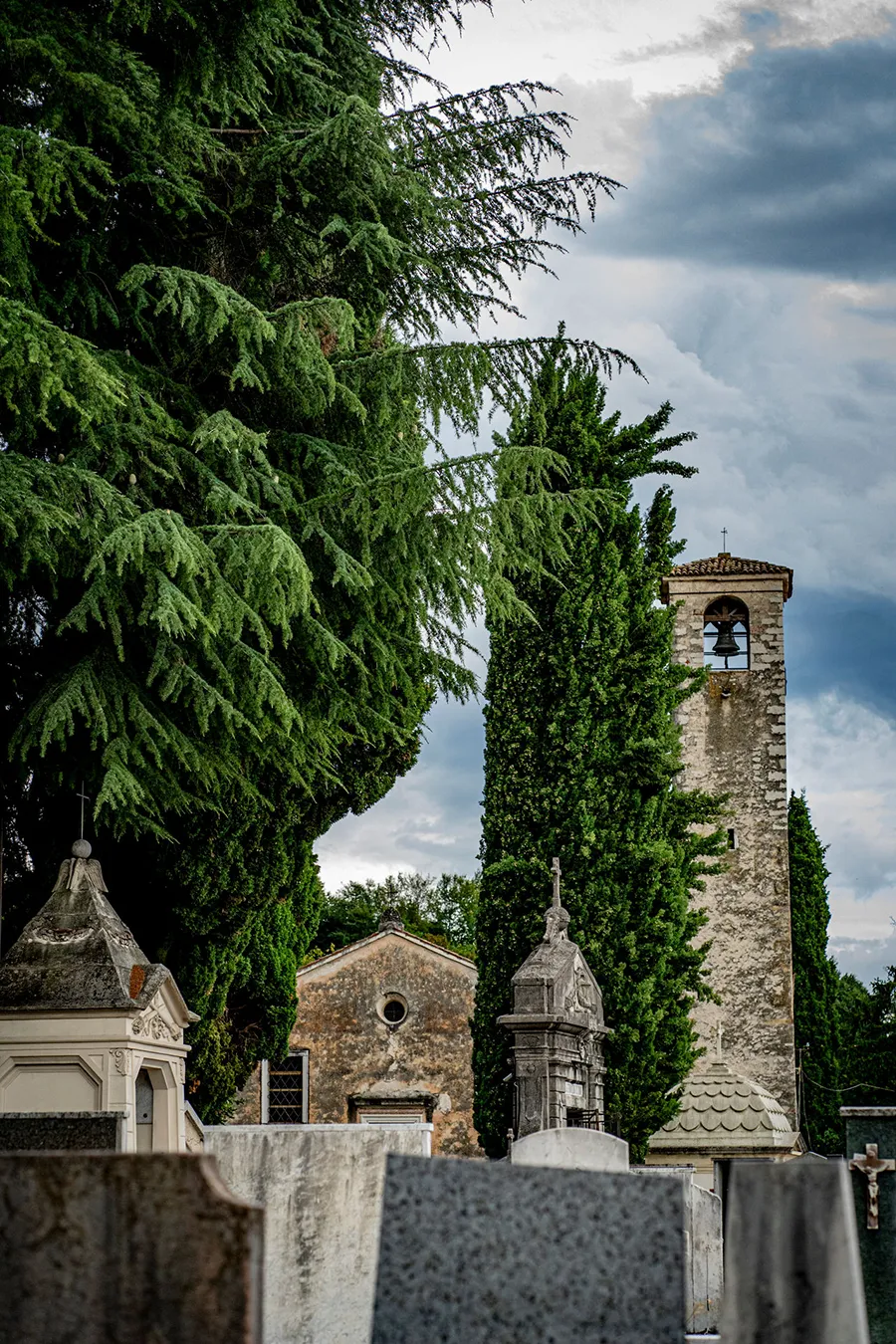
Around 1840, it became necessary to expand the cemetery area because the area around the old San Marco parish church was unusable. The work was entrusted to engineer Ausilio Manera (1787-1870), son of a cousin of the sculptor Antonio Canova, who demolished the old rectory and designed a large boundary wall. The oldest tombstone preserved today is that of the cleric Giovanni Colombana, a cleric in the seminary of Padua, who died at only 20 years old in August 1855. The text of the epitaph was dictated by his fellow student, Giuseppe Sarto, the future Pope Pius X. In the 19th-century cemetery area, it is possible to see the equestrian tomb-monument of the Rossi family, who, with Giovanni (1830-1882) and his son Giuseppe, a supreme charioteer (1852-1910), were protagonists of the European trotting world. Giuseppe’s bust covers the tomb, dominating the bas-relief which transfigures the history of horse racing from its origins to their time.
Address
Via S. Pancrazio, 9, 31017 Crespano di Pieve del Grappa (TV)
Phone number
0423 53065
E-mail
crespano@diocesipadova.it