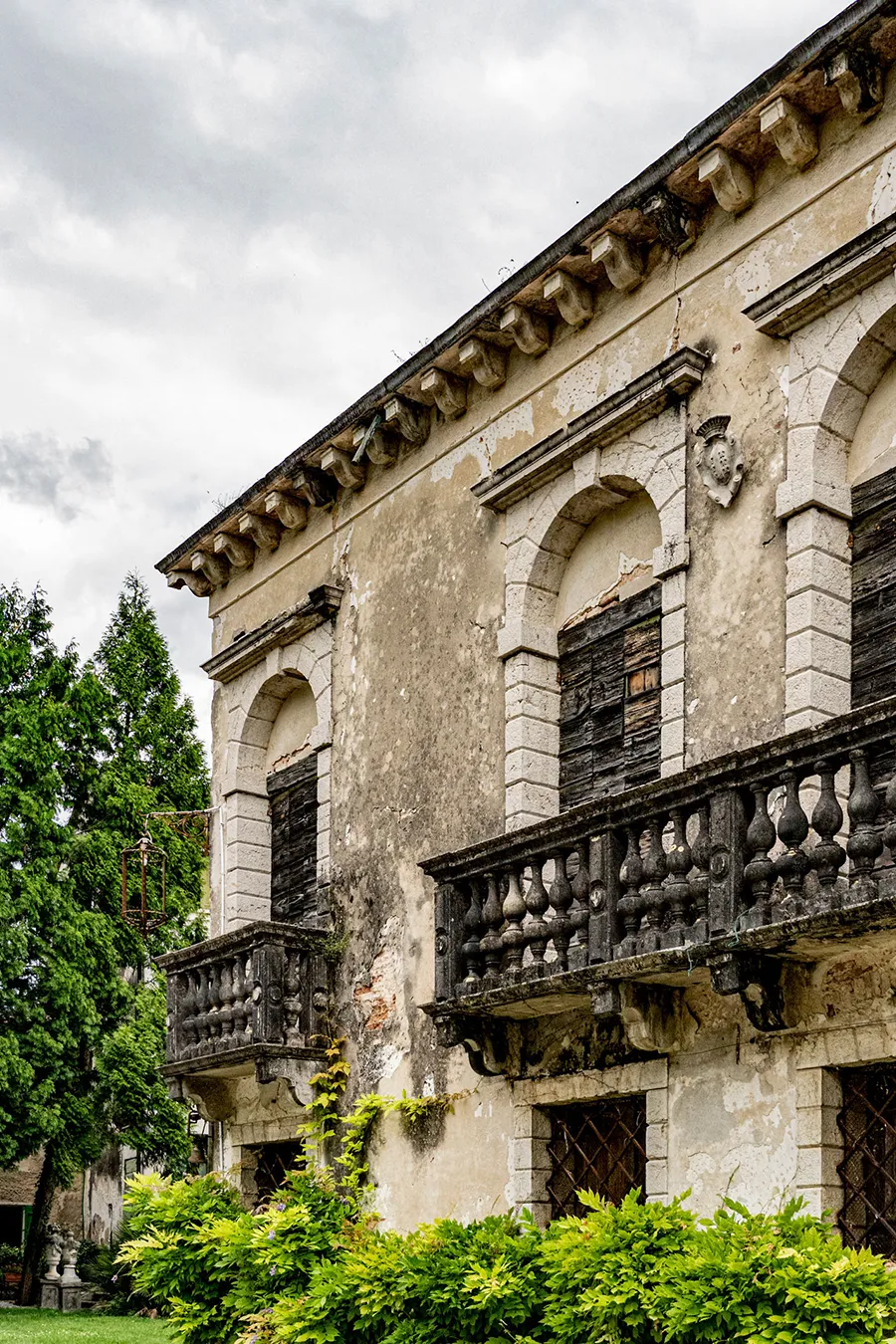
Villa Manfrotto Canal is registered with the Regional Institute of Venetian Villas with identification code 00002878. It is located in the district called Gherla, west of the town, on the border with the community of Sant’Eulalia. It is reached from Via Molinetto along an tree-lined avenue bordered by a boundary wall that hides the view of the orchard: the entrance is marked by two large pilasters supporting statues of Apollo and Diana, attributed to the Marinali workshop. The Manfrotto family, in Crespano since the 15th century, was its original owner until the 17th century when the entire property passed to the Canal family, who are the current owners. The Villa has an elongated building, with a simple architectural composition, with three regular orders of windows. The entrance, preceded by a short staircase, is surmounted by a stone balustrade ; in the center of the facade is affixed the stone coat of arms of the Manfrotto family, depicting a hand holding a distaff, commemorating their wool textile activity. The barchesse and the guesthouse in front, erected by Agostino Manfrotto, bear the date 1612-1615.
Dating from 1788 is the airy and elegant neoclassical loggia, commissioned by Don Filippo Maria when he decided to restore the pre-existing barchessa ; it adjoins the facade to the north, surpassing it ; the large columned volume, atypical in the context of Venetian villas, is rhythmically decorated on its walls with polychrome stucco bas-reliefs, and extends, as an invitation, towards the Oratory of the Madonna dell’Assunta, located in the western corner of the orchard. To the south, the noble complex is completed by the loggia with guesthouse, the wine cellar, and the granaries with the cellar ; above the entrance to this, a 17th-century fresco of Bacchus toasting is visible. In front of the residence entrance, an octagonal stone fountain embellishes the garden.
GHERLA DISTRICT
The Gherla is a very old settlement, already mentioned in documents in the second half of the 11th century ; its urban layout remained almost unchanged over the centuries and developed around the road that, from the current Via Molinetto, ascends towards the sub-mountain slope. Gathering several peasant families, it is articulated in many small courtyards, whose access is marked by characteristic entrances with stone arches facing the street. In addition to fields and livestock, the Gherla community must have played a role in textile labor under the Manfrottos: an ancient and not only economic link, as proven also by the affection of the people of the district for the Madonna dell’Assunta and the Oratory dedicated to her.
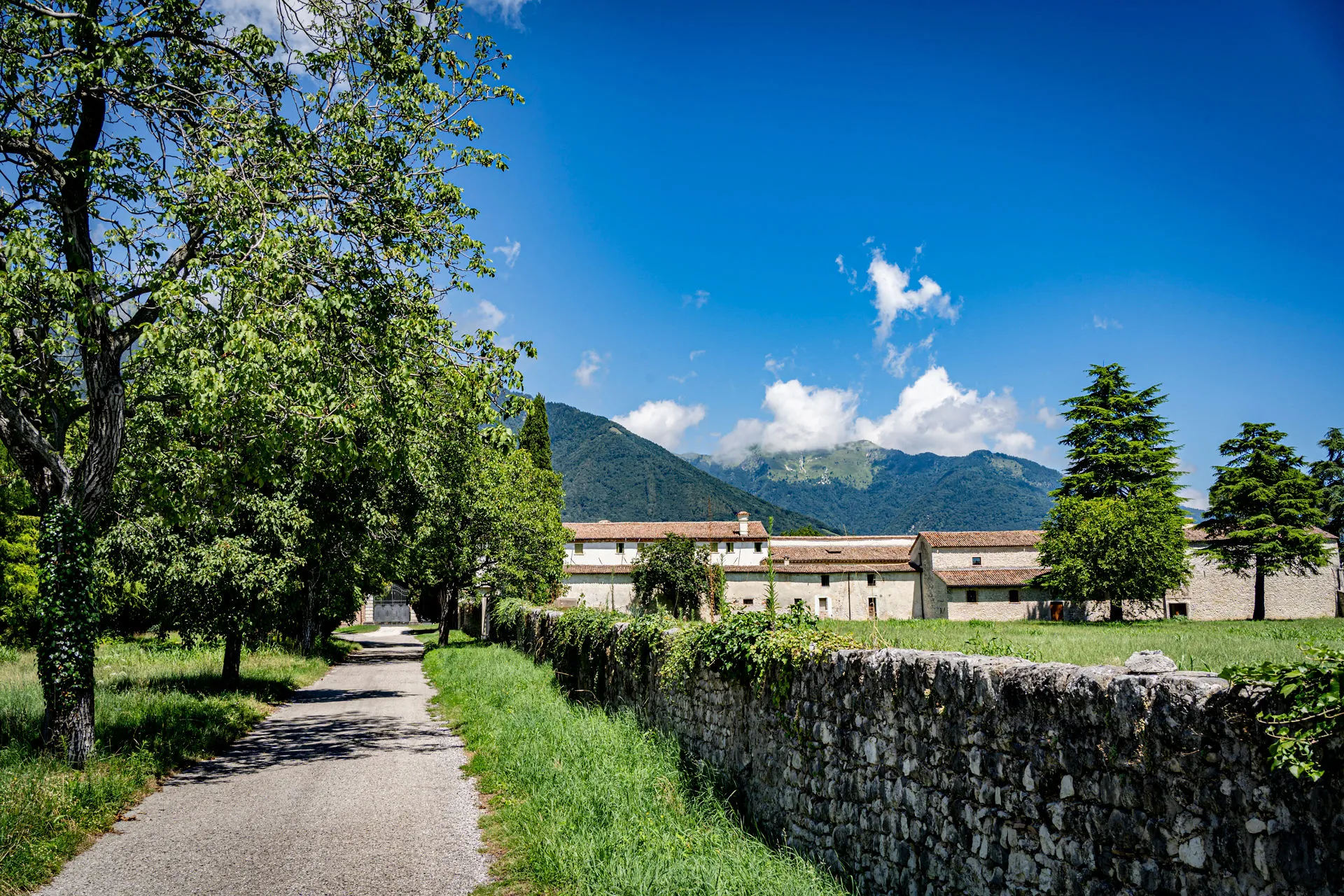
You can visit the exterior and the barchessa every first Friday of the month from 9:00 to 11:00